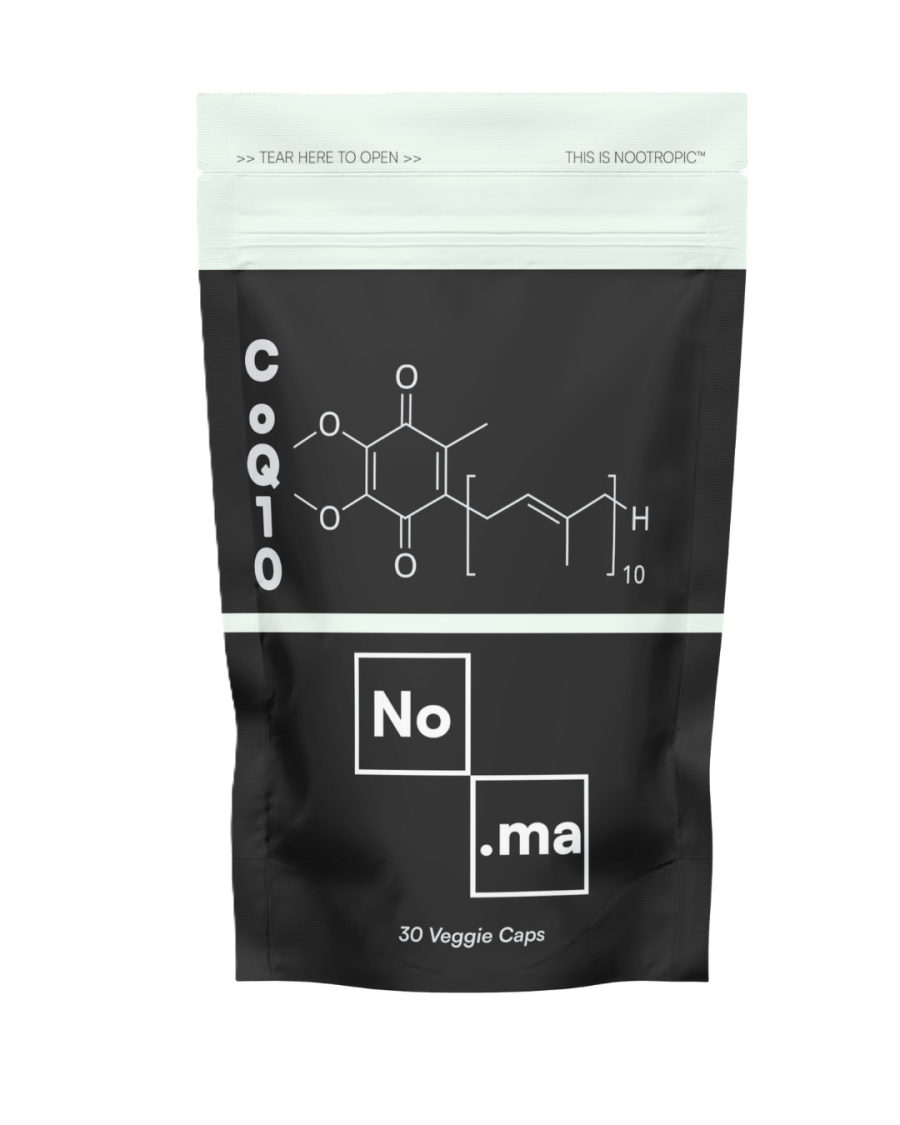

Coenzyme Q10 (CoQ10, ubiquinone) is the only lipid-soluble molecule synthesized by the body whose role in the mitochondrial respiratory chain is irreplaceable. Its function: transporting electrons from Complexes I and II to Complex III of the inner mitochondrial membrane. This shuttling is the engine of oxidative phosphorylation — the pathway that produces ~95% of cellular ATP. Without CoQ10, the respiratory chain halts and energy production collapses. The most affected tissues are those with the highest ATP consumption: heart, skeletal muscles, brain, and liver.
CoQ10 plays a dual role, energetic and antioxidant. Its reduced form (ubiquinol, CoQH₂) is one of the few lipid-soluble antioxidants naturally present in all cell membranes. It protects mitochondrial membrane phospholipids from oxidation — essential since these membranes are the site of energy production. Endogenous synthesis peaks at around 20-25 years, then declines continuously: approximately -20% at age 40, -40% at age 60. Intensive exercise, chronic stress, and cellular aging accelerate this decline.
The most underestimated point: statins (simvastatin, atorvastatin, rosuvastatin) inhibit HMG-CoA reductase — the same enzyme used to synthesize CoQ10 (shared mevalonate pathway). Statin patients have significantly reduced CoQ10 levels, which may contribute to statin-associated myopathy (muscle pain and weakness). Many cardiologists recommend CoQ10 supplementation for patients on statin therapy. If you take statins, discuss CoQ10 with your prescribing physician.
Absolute usage rule: CoQ10 is lipophilic — taken on an empty stomach, its absorption is near zero. It must be taken with a fat-containing meal (olive oil, avocado, eggs, nuts) to achieve optimal bioavailability. Our CoQ10 is produced by bacterial fermentation (Rhodobacter sphaeroides, non-GMO), purity ≥99%, HPMC vegetal capsule. Direct synergy with ALCAR: ALCAR transports fatty acids to the mitochondria, CoQ10 converts them to ATP. Two complementary mitochondrial co-factors.